
Emotion grid
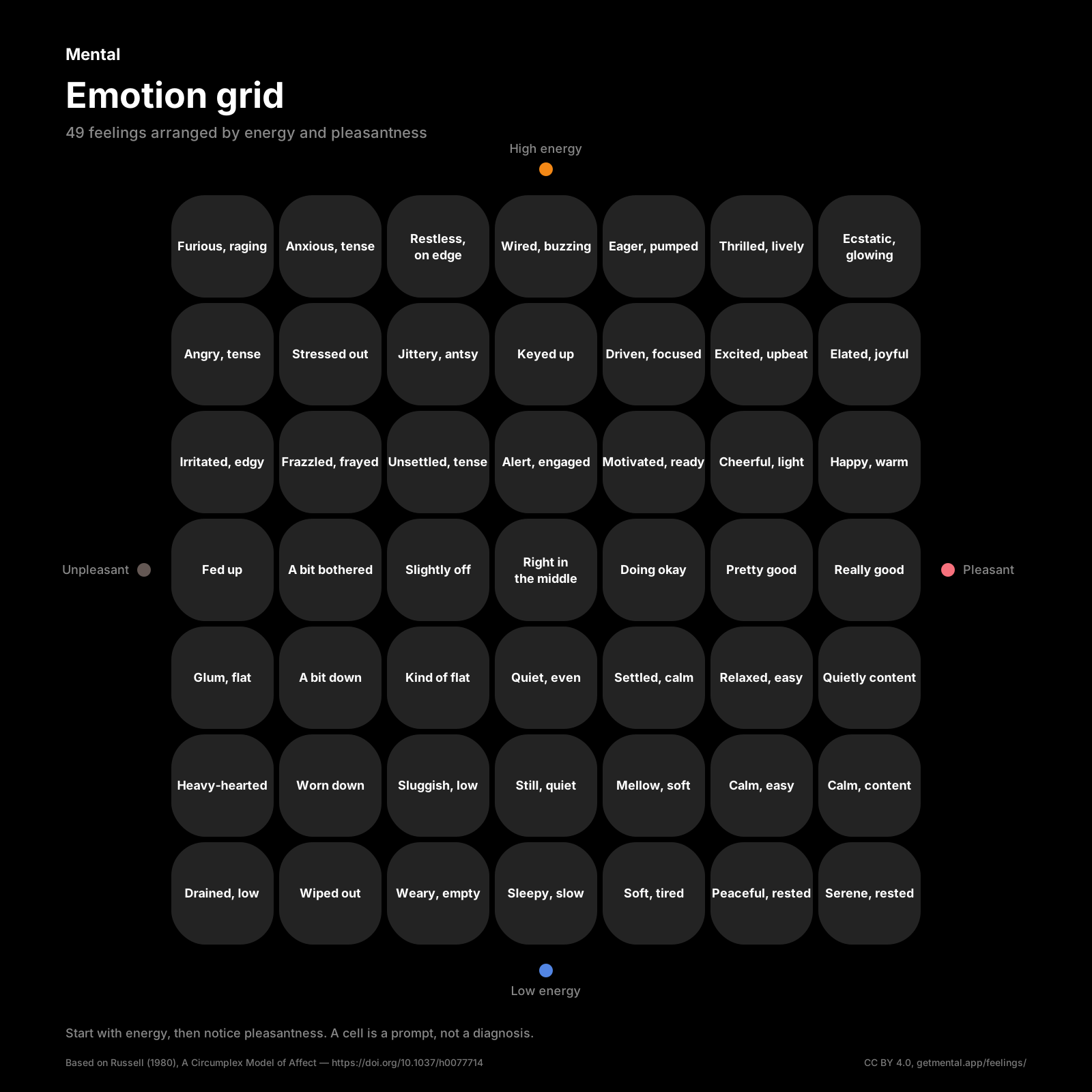
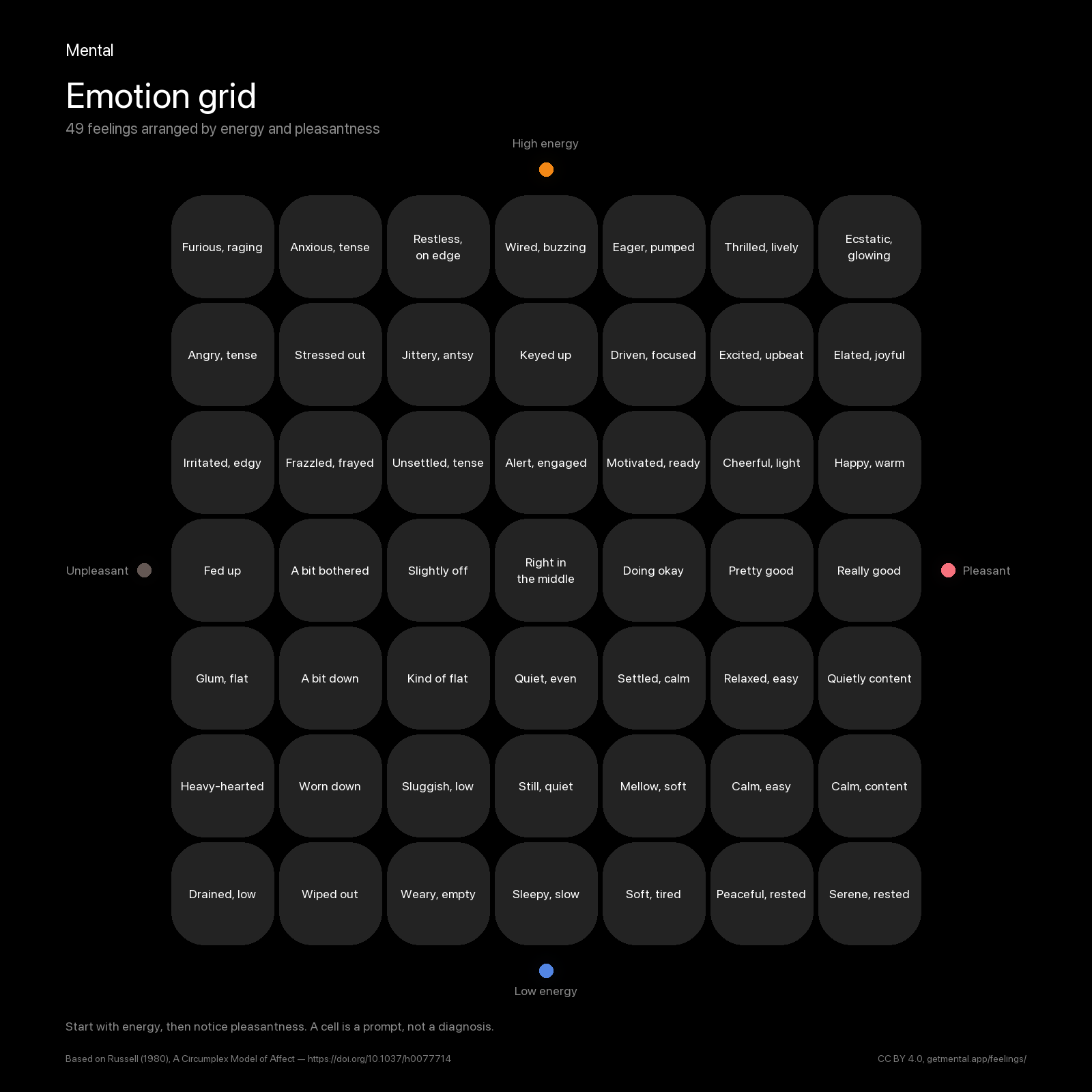
An emotion grid is a map of feeling words arranged by two dimensions: energy from low to high, and pleasantness from unpleasant to pleasant.
Point at a cell to see, or just use the arrow keys.
The 7×7 affect grid: pick a cell to name a feeling
Furious, raging
About as much energy as you carry, and it feels about as bad as it gets.
Anxious, tense
About as much energy as you carry, and it feels bad.
Restless, on edge
About as much energy as you carry, and it leans unpleasant.
Wired, buzzing
About as much energy as you carry, and it sits neither pleasant nor unpleasant.
Eager, pumped
About as much energy as you carry, and it leans pleasant.
Thrilled, lively
About as much energy as you carry, and it feels good.
Ecstatic, glowing
About as much energy as you carry, and it feels about as good as it gets.
Angry, tense
High energy, and it feels about as bad as it gets.
Stressed out
High energy, and it feels bad.
Jittery, antsy
High energy, and it leans unpleasant.
Keyed up
High energy, and it sits neither pleasant nor unpleasant.
Driven, focused
High energy, and it leans pleasant.
Excited, upbeat
High energy, and it feels good.
Elated, joyful
High energy, and it feels about as good as it gets.
Irritated, edgy
A little more energy than usual, and it feels about as bad as it gets.
Frazzled, frayed
A little more energy than usual, and it feels bad.
Unsettled, tense
A little more energy than usual, and it leans unpleasant.
Alert, engaged
A little more energy than usual, and it sits neither pleasant nor unpleasant.
Motivated, ready
A little more energy than usual, and it leans pleasant.
Cheerful, light
A little more energy than usual, and it feels good.
Happy, warm
A little more energy than usual, and it feels about as good as it gets.
Fed up
An ordinary amount of energy, and it feels about as bad as it gets.
A bit bothered
An ordinary amount of energy, and it feels bad.
Slightly off
An ordinary amount of energy, and it leans unpleasant.
Right in the middle
An ordinary amount of energy, and it sits neither pleasant nor unpleasant.
Doing okay
An ordinary amount of energy, and it leans pleasant.
Pretty good
An ordinary amount of energy, and it feels good.
Really good
An ordinary amount of energy, and it feels about as good as it gets.
Glum, flat
A little less energy than usual, and it feels about as bad as it gets.
A bit down
A little less energy than usual, and it feels bad.
Kind of flat
A little less energy than usual, and it leans unpleasant.
Quiet, even
A little less energy than usual, and it sits neither pleasant nor unpleasant.
Settled, calm
A little less energy than usual, and it leans pleasant.
Relaxed, easy
A little less energy than usual, and it feels good.
Quietly content
A little less energy than usual, and it feels about as good as it gets.
Heavy-hearted
Low energy, and it feels about as bad as it gets.
Worn down
Low energy, and it feels bad.
Sluggish, low
Low energy, and it leans unpleasant.
Still, quiet
Low energy, and it sits neither pleasant nor unpleasant.
Mellow, soft
Low energy, and it leans pleasant.
Calm, easy
Low energy, and it feels good.
Calm, content
Low energy, and it feels about as good as it gets.
Drained, low
Almost no energy at all, and it feels about as bad as it gets.
Wiped out
Almost no energy at all, and it feels bad.
Weary, empty
Almost no energy at all, and it leans unpleasant.
Sleepy, slow
Almost no energy at all, and it sits neither pleasant nor unpleasant.
Soft, tired
Almost no energy at all, and it leans pleasant.
Peaceful, rested
Almost no energy at all, and it feels good.
Serene, rested
Almost no energy at all, and it feels about as good as it gets.
How to use the grid in 30 seconds
Start with energy. Are you activated, ordinary, or slowed down? That chooses a row. Then notice pleasantness. Does the moment feel unpleasant, pleasant, or somewhere between? That chooses a column. Pick the closest phrase and treat it as a working description, not a verdict. If you are keeping a daily mood check-in, add one short line about what was happening.
Four emotion quadrants
A simpler feelings chart divides the same two axes into four emotion quadrants: high-energy unpleasant, high-energy pleasant, low-energy unpleasant, and low-energy pleasant. This grid keeps those directions but adds seven steps on each axis, so nearby feelings do not collapse into the same broad category.
Worked example
After a difficult meeting, you may notice high energy and an unpleasant tone. Compare anxious, tense with angry, tense. The useful question is not which label is objectively correct, but which phrase better describes this moment and what detail made it fit.
Grid vs feelings wheel
A feelings wheel starts from categories and helps you move toward more specific words. An emotion grid starts with two sensations you can usually answer without already knowing the word: energy and pleasantness. Use a wheel when categories feel intuitive; use this grid when you want to locate a feeling from the body of the moment.
Why phrases, not single words
Most feelings lists are single words, which sounds precise and works badly. If you do not already have the vocabulary, "languid" does not help you find yourself. Every cell here is a short phrase in ordinary language, written so that neighbouring cells read differently — you should be able to tell sluggish, low from kind of flat without a dictionary.
This also means the grid is deliberately not exhaustive. Forty-nine is not the number of feelings that exist. We use forty-nine phrases to offer more nuance while keeping the grid manageable for a daily check-in.
Methodology and limitations
The two-axis structure is based on James A. Russell’s 1980 paper “A Circumplex Model of Affect”. Mental’s 49 everyday-language phrases are an editorial interpretation of that space. They are not a clinical scale, a diagnostic instrument, or an exhaustive list of emotions. Neighbouring cells are meant to stay plausible; two people can reasonably name the same moment differently.
Download and use in education
The downloadable grid is suitable for personal reflection, workshops, classrooms, and facilitated conversations. Invite people to choose, pass, or keep their answer private; do not infer a diagnosis or make a high-stakes decision from one cell. If you use the grid in Mental, you can also read how Mental handles journal data.
- SVG emotion gridScalable for screens and large print.
- PNG emotion gridReady for slides and documents.
- Printable PDF gridOne-page landscape handout.
- Facilitator notesPrompts, limitations, and source guidance.
The downloadable educational assets are licensed under Creative Commons Attribution 4.0. Suggested credit: “Mental emotion grid — getmental.app/feelings/”. Attribution does not require a followed or keyword-rich link.