
Feelings chart for adults
Forty-nine feelings on one page, arranged by how much energy you have and how pleasant it feels. Print it, pin it up by your desk, or keep it next to your journal.
Print it
- Printable feelings chartPDF, one page, US Letter landscape. Black on white, so it costs almost no ink.
- Feelings chart, SVGScales to any paper size, A4 included, and to a poster.
- Facilitator notesPrompts and limits for using the chart with a group.
How to read it
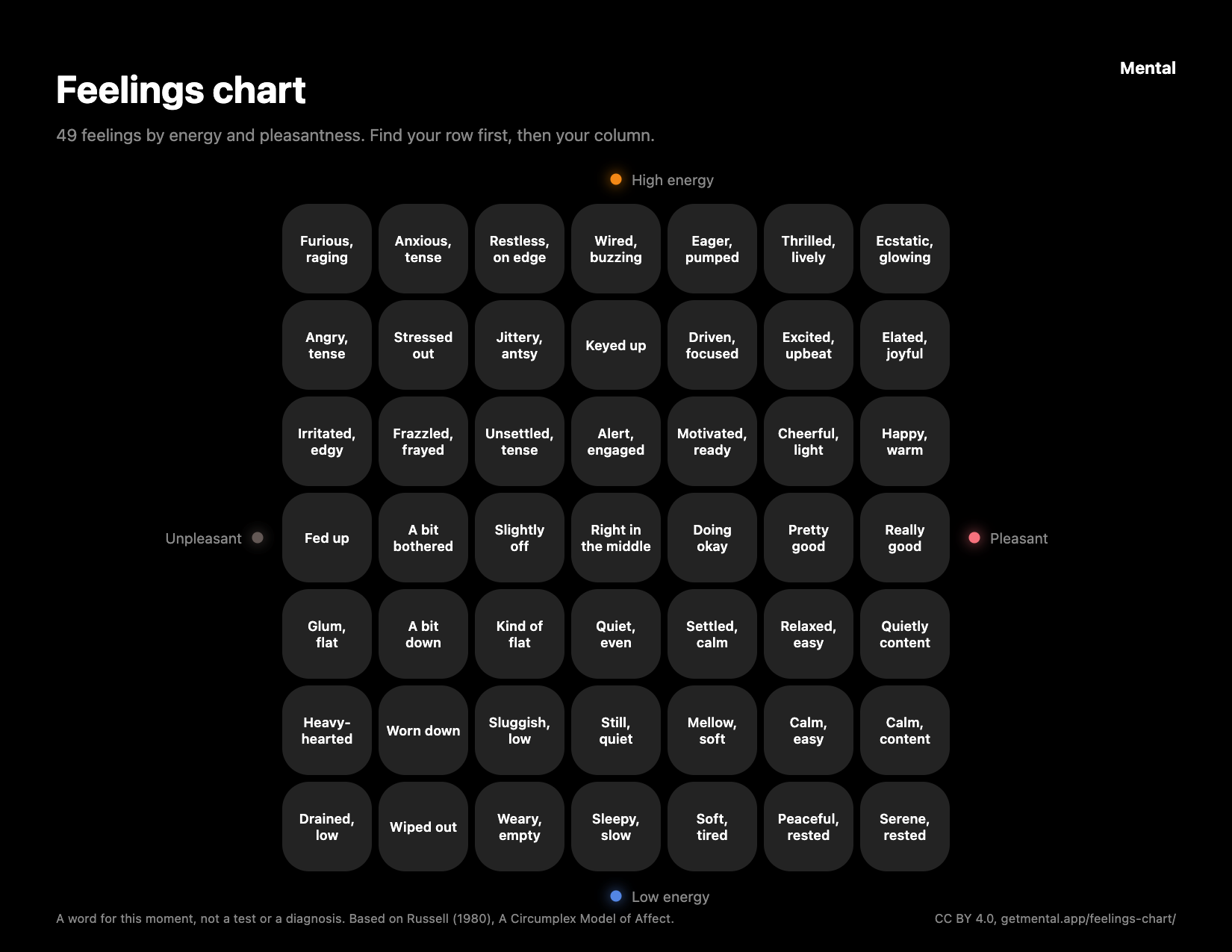
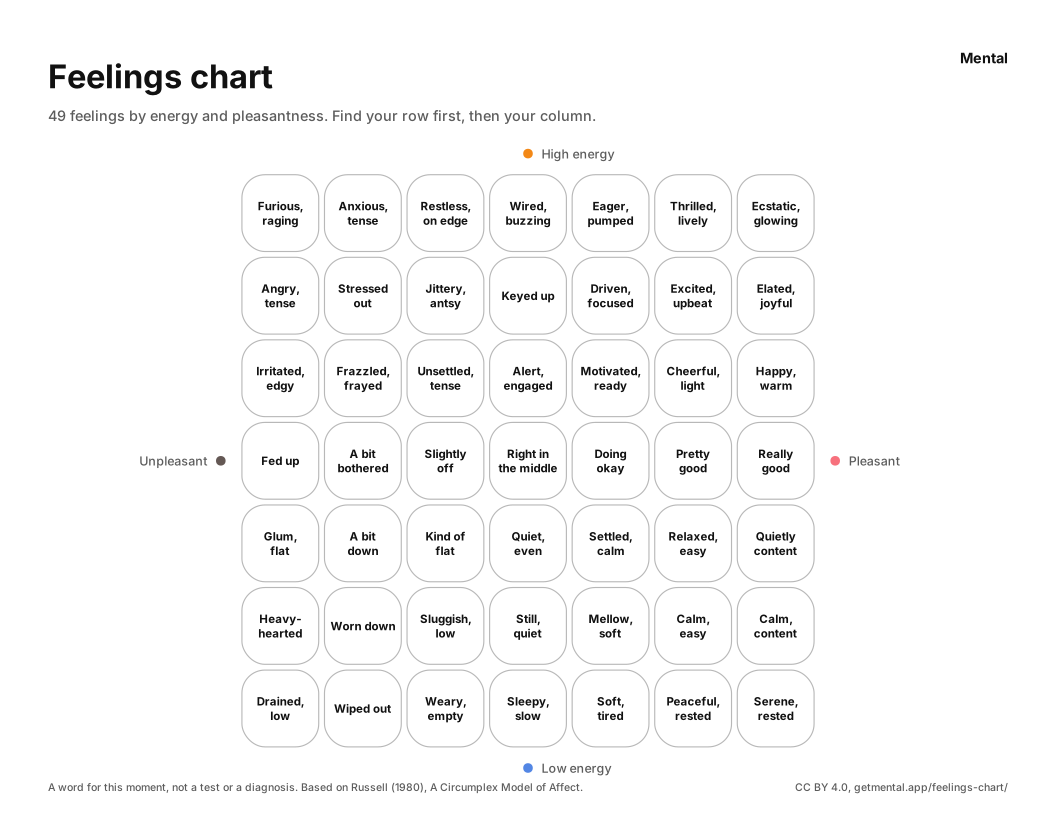
Rows are energy: very high at the top, very low at the bottom. Columns are pleasantness: very unpleasant on the left, very pleasant on the right. Find your row first. Are you charged, ordinary or tired? Then move along the row until a phrase fits.
Treat the phrase as a working description, not a verdict. If two neighbours both fit, keep both. Feelings shift through the day, and a chart only names this moment.
Ways to use a printed chart
Next to your journal. Pick a phrase before you write and let it be the first line. It is easier to start from a word than from a blank page.
On the fridge or by the desk. A glance in the morning and one in the evening is enough. Nobody has to see what you chose.
In a group or a session. Invite people to point, pass or keep their answer to themselves. The facilitator notes cover prompts and what the chart can’t tell you.
Phrases instead of faces
Many feelings charts are made for children, with a face for every feeling. Adults usually need finer distinctions: worn down is not heavy-hearted, and keyed up is not anxious. Every cell here is a short phrase in everyday language, and neighbouring cells are written to read differently. The phrases are the same 49 that the Mental app uses for a check-in.
The 49 feelings, row by row
Each row runs from the least pleasant to the most pleasant.
Very high energy: Furious, raging; Anxious, tense; Restless, on edge; Wired, buzzing; Eager, pumped; Thrilled, lively; Ecstatic, glowing.
High energy: Angry, tense; Stressed out; Jittery, antsy; Keyed up; Driven, focused; Excited, upbeat; Elated, joyful.
A little more energy than usual: Irritated, edgy; Frazzled, frayed; Unsettled, tense; Alert, engaged; Motivated, ready; Cheerful, light; Happy, warm.
Ordinary energy: Fed up; A bit bothered; Slightly off; Right in the middle; Doing okay; Pretty good; Really good.
A little less energy than usual: Glum, flat; A bit down; Kind of flat; Quiet, even; Settled, calm; Relaxed, easy; Quietly content.
Low energy: Heavy-hearted; Worn down; Sluggish, low; Still, quiet; Mellow, soft; Calm, easy; Calm, content.
Very low energy: Drained, low; Wiped out; Weary, empty; Sleepy, slow; Soft, tired; Peaceful, rested; Serene, rested.
Prefer it on screen?
On the emotion grid you can point at any cell and read what it is like. If you don’t know where to start, two questions lead you to a cell. And if you want more words, the feelings list compares nearby ones.
What it is, and what it isn’t
The chart helps you put a moment into words. It is not a test, a score or a diagnosis, and it doesn’t say why you feel a certain way. Its two axes follow James A. Russell’s 1980 paper “A Circumplex Model of Affect”; the phrases are Mental’s own.
You are free to print, share and adapt it under Creative Commons Attribution 4.0. Suggested credit: “Mental feelings chart, getmental.app/feelings-chart/”.
Keep a history
In Mental, these 49 feelings are the check-in. Once you have five check-ins in a month, made at more than one time of day, its mood clock shows when you felt better and worse.