A weekly review starts with more than what you didn't finish.
Look at what happened, not just what stayed on the list. Choose something to continue, something to change, or something you can close. Then give one next action a place.
The week is evidence to look at, not a verdict on you.
What does this weekly review cover?
This is a small review of personal notes: reread the week, notice what deserves attention, and choose a next step. The full GTD Weekly Review also examines a wider system of tasks, projects and commitments. If you use that system, use its official checklist; this journal-based format is an independent, narrower practice.
A fictional week / 12–16 October 2026
The draft is unfinished. That is one fact.
At first, Ari remembers a week of failing to finish a project draft. Five short notes contain more information. Ari and these entries are fictional.
The notes / before the interpretation
Monday
Lunch outside. Glad I went. Still no opening paragraph.
Tuesday
Opened chat at nine. Didn't open the draft until 10:10.
Wednesday
Walked at lunch. Enjoyed the river, but tired again by three after the noisy morning.
Thursday
Chat first again. Lost where I meant to start. Workshop invitation still unanswered; I know I can't go.
Friday
Opened the draft first and wrote a rough paragraph. The whole piece is still unfinished.
The reasoning / what can I take from this?
Keep the exception in view.
Two lunch notes describe something Ari enjoyed. Wednesday also contains tiredness. That supports choosing another walk, not a claim that walks fix every afternoon.
Two mornings began with chat and a delayed draft. Friday suggests a different opening is worth trying. It does not prove why the earlier mornings went that way.
The invitation is a different kind of open loop: Ari already knows the answer. It needs a kind response, rather than another week of reconsidering.
Three decisions, each attached to a note
Continue
Keep a lunch outside.
Choose it because it was welcome on Monday and Wednesday. A tired afternoon does not erase that, or need to be explained away.
Change
Try the document before chat.
Use Friday's start as a small experiment for Monday. The aim is to begin the paragraph, not finish the whole project at nine.
Close
Decline the workshop invitation.
Ari can send “Thanks for thinking of me; I can't make this one.” Once sent, mark the invitation answered.
One next action
Monday, 19 October, at 9:00
Open the draft and write its next rough sentence before opening chat. Put that in the existing calendar; add a Friday check-in to see what happened.
The review ends with a choice and a place to find it. Ari does not have to finish the draft, clear the inbox and reorganise every note while reviewing the week.
A fictional week / a small card for the next one
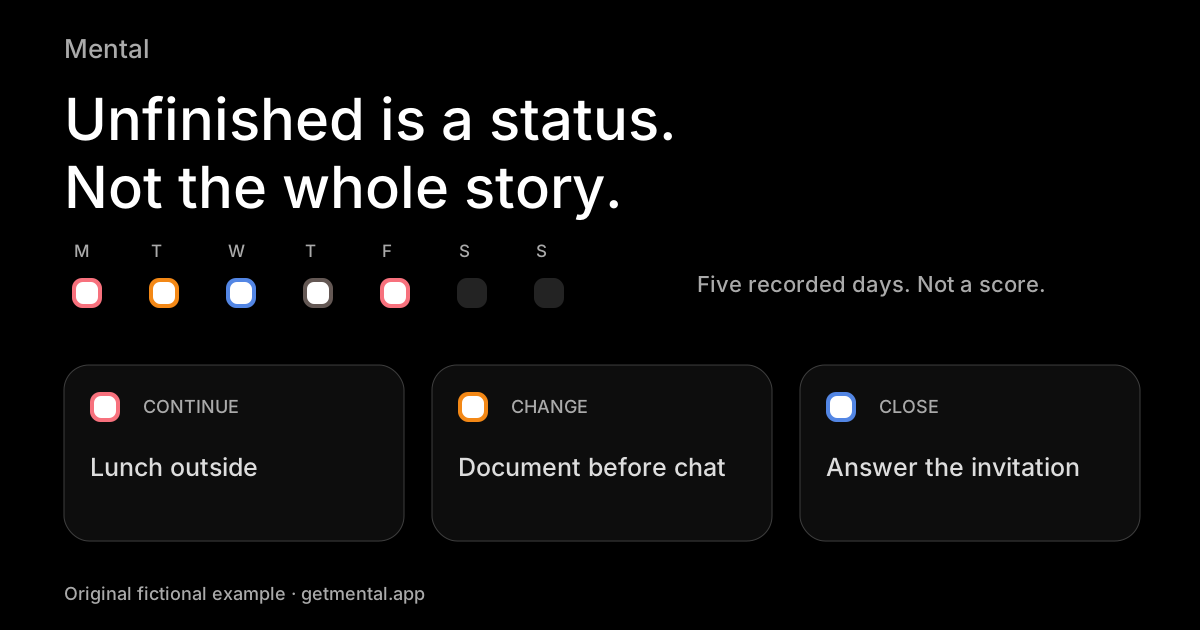
Unfinished is a status. It isn't the whole story.
Continue / lunch outside
I enjoyed it. It didn't have to fix the afternoon.
Change / the opening move
Try the document before chat.
Close / the invitation
I know the answer. Send it kindly.
Next / Monday at 9:00
Open the draft. Write one rough sentence.
A weekly review can preserve something worth keeping, change one approach and close one open loop.
Mental — getmental.app/weekly-review/
A weekly review checklist with a stopping point
Gather enough to remember. Open your calendar and a handful of notes from the week. You do not need to put every record into a new system.
Read before judging. What happened? What mattered? Which detail complicates the neat story you first told yourself?
Choose what to continue, change or close. Any category can stay empty. Keep the note that supports each choice beside it.
Name one observable next action. “Be more focused” is hard to recognise. “Open the document before chat on Monday” can be checked.
Give it a home and stop. Put the action in your existing task list or calendar. Pick when to look again. Doing the work is a separate session.
If something keeps expanding the review, capture it as a separate action: “sort the old project folder” or “ask which deadline changed.” The review does not need to become an immediate clear-out of everything you discover.
Make next week's card
Choose at least one thing to continue, change or close. There is no need to fill every field to make the review count.
This free web tool is separate from the Mental app. Answers stay in this page's memory, with no account, upload, autosave or AI processing. Reloading clears them. Download your card if you want to keep it; the date does not create a reminder.
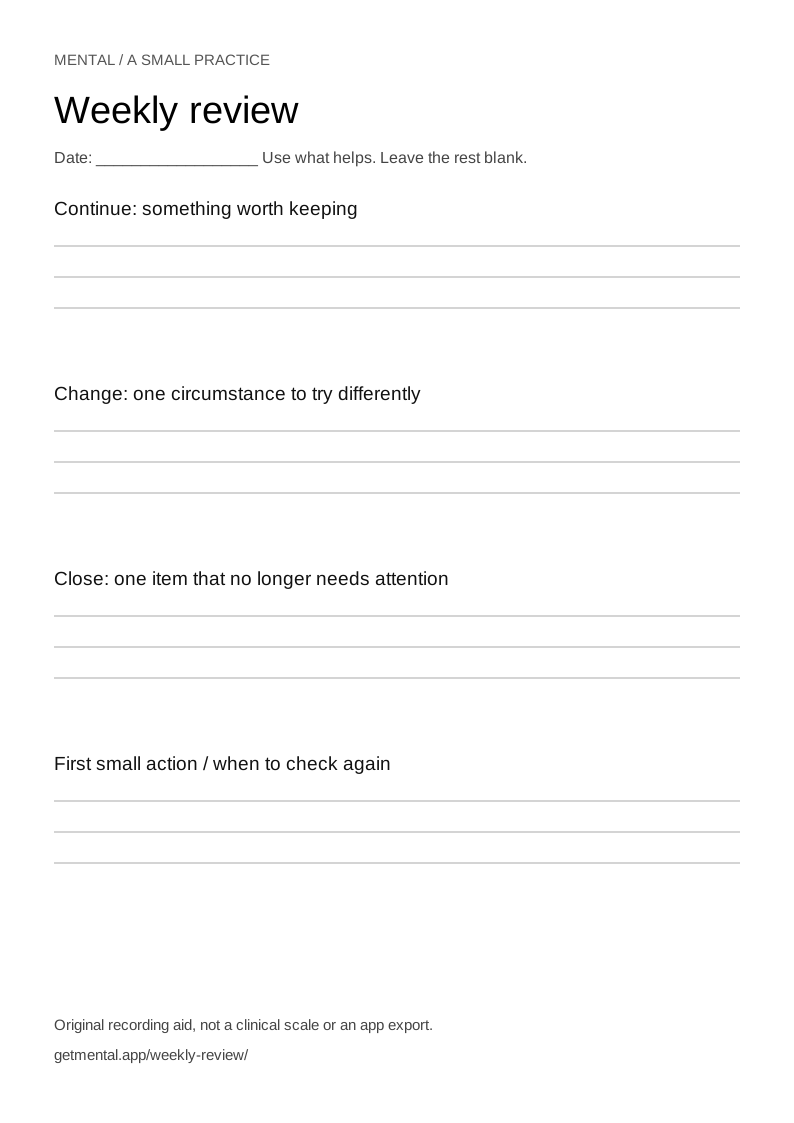
A card you can keep on paper
An original one-page worksheet for continue, change, close and the next step. Save the SVG, open it in a browser and print, or choose Save as PDF.
Mental's calendar and notes can give you material to reread. Return to the particular day before deciding what a repeated feeling means. Memory can help carry context forward; your review still needs the source notes and your judgement. This card is a separate web tool, not an app task manager.
David Allen Company: GTD Weekly Review checklist describes the full system review. Our continue/change/close format, worksheet and fictional week are original editorial examples. A few personal notes can inform a choice; they do not establish what caused a feeling or predict next week.
 MentalDownload for iOS