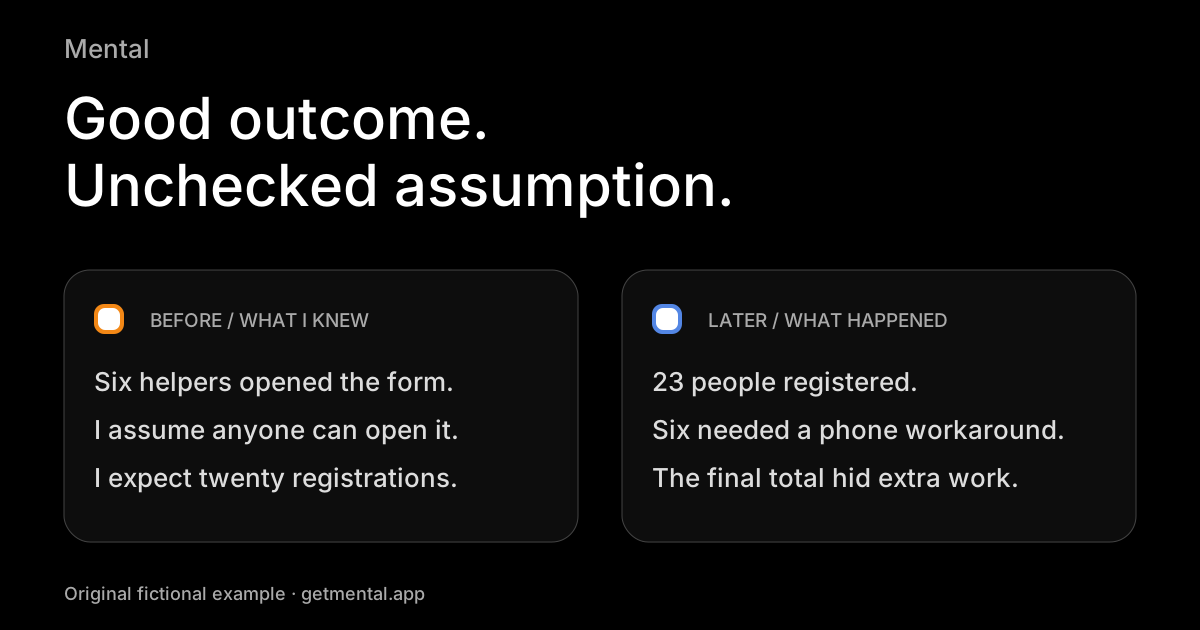
Keep the starting point. Add the ending beside it.
What goes in a decision journal?
A decision journal records your reasoning before a choice: what you knew, the options you considered, what you chose and what you expected. A later review adds the outcome without rewriting the original record. A pros-and-cons list compares options; this also preserves a prediction you can return to.
A fictional project / two dates
The signup target was met. The assumption was still wrong.
Nell is organising a neighbourhood seed swap. She needs a way for people to register, and has to choose how much to build. Nell, the project and all numbers below are fictional.
Before / 5 October 2026
Use the existing form.
Facts available
Forty neighbours will receive the invitation. The existing form takes one evening to adapt. Six helpers opened it successfully during a trial.
Alternative
Build a separate signup page over four evenings. It offers more control, but leaves less time to prepare the event.
Choice and reason
Use the form and spend the saved evenings on the seed labels and collection plan.
Expectation
At least twenty people will register by 16 October. I assume invitees can open the form without an account.
Confidence
70% that twenty or more will register. This is my estimate, not a calculated forecast.
What would change my mind
If someone outside the helper group cannot open it, change the access setting or choose another route.
Review
19 October, after registration closes.
Later / 19 October 2026
Twenty-three registered. Six needed another route.
Outcome
Seventeen people registered through the form. A helper collected another six names by phone after those neighbours could not open it.
New information
The phone workaround made the final total look successful. Nell had not expected that extra work.
Available, but missed
The form required a sign-in. The six trial helpers were already signed in, so their successful test did not check access for everyone.
Reasoning to keep
Reusing something simple protected preparation time. Building a new page was not automatically necessary.
Reasoning to change
Test the actual assumption: open the invitation while signed out before sending it to the group.
The target alone says “worked.” The two records show why that is incomplete. Reusing the form was a defensible trade-off; treating six signed-in helpers as an access test was a gap Nell could have checked at the time.
One fictional decision / two different questions
What did I know?
The form worked for six helpers. I had not tested it while signed out.
What happened?
The target was met because a helper took six registrations by phone.
A good outcome can hide an unchecked assumption.
A decision journal keeps the original reasoning beside the result, so one does not stand in for the other.
Mental — getmental.app/decision-journal/
A small template you can actually return to
Write the decision, an expectation you could recognise later, and a review point. “It will go well” is difficult to compare with reality. “Twenty people register by Friday” gives the later record something specific to answer.
Add the context and serious alternative when they matter. Include the assumptions beneath the facts: “six helpers opened it” is an observation; “everyone can open it” is an inference. Confidence preserves your estimate at the time; it is not a score for the quality of the choice.
Make a before-decision brief
The decision and expected outcome are the starting point. The other fields are optional; use the detail your choice deserves.
This free web tool is separate from the Mental app. Answers stay in this page's memory, with no account, upload, autosave or AI processing. Reloading clears them. Download the brief to keep the starting point for your later review.
Your estimate of the expected outcome. It is not a calculated probability or a grade for your decision.
Review what happened without editing what you knew
Find a useful review point. Choose when relevant information should exist: after registration closes, after a trial ends, or when the promised answer arrives. There is no universal six-month rule.
Keep the original. Save a dated name such as “2026-10-05 — seed-swap signup.” Put a separate check-in in the calendar or list you already use.
Add a dated review. Record the outcome, genuinely new information, and anything available earlier that you missed. If the result is still unknown, write that and choose whether to check again.
Ask what to repeat. With the same information, what was reasonable? What assumption would you test next time? An unlucky result alone does not answer either question.
The downloaded brief leaves its later-review section blank. This page does not store it or send a reminder; the file and your chosen calendar entry are how you return.
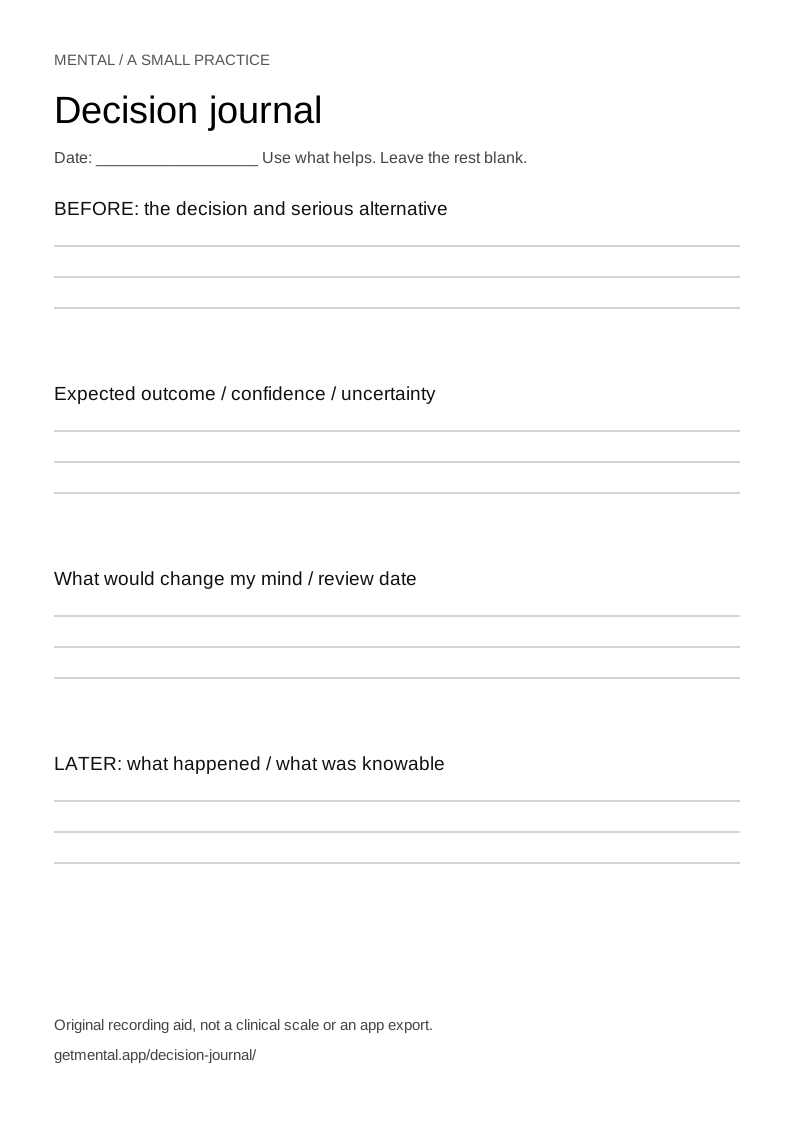
Keep the before and after on paper
An original one-page worksheet with space for the later review. Save the SVG, open it in a browser and print, or choose Save as PDF.
A Mental note can preserve how a choice felt and what was happening around it. That can sit alongside the decision brief. Mental is not a dedicated forecast-calibration system; keep the source record and use your own judgement when reviewing it.
 MentalDownload for iOS