A thought can be worth keeping without becoming an obligation.
What is a brain dump?
A brain dump is an unpolished record of the thoughts competing for your attention. Here, that means everyday thoughts and loose ends, rather than the study exercise of recalling what you learned. You can write in a notebook or a plain text file; sorting is a separate, optional step.
One fictional Friday
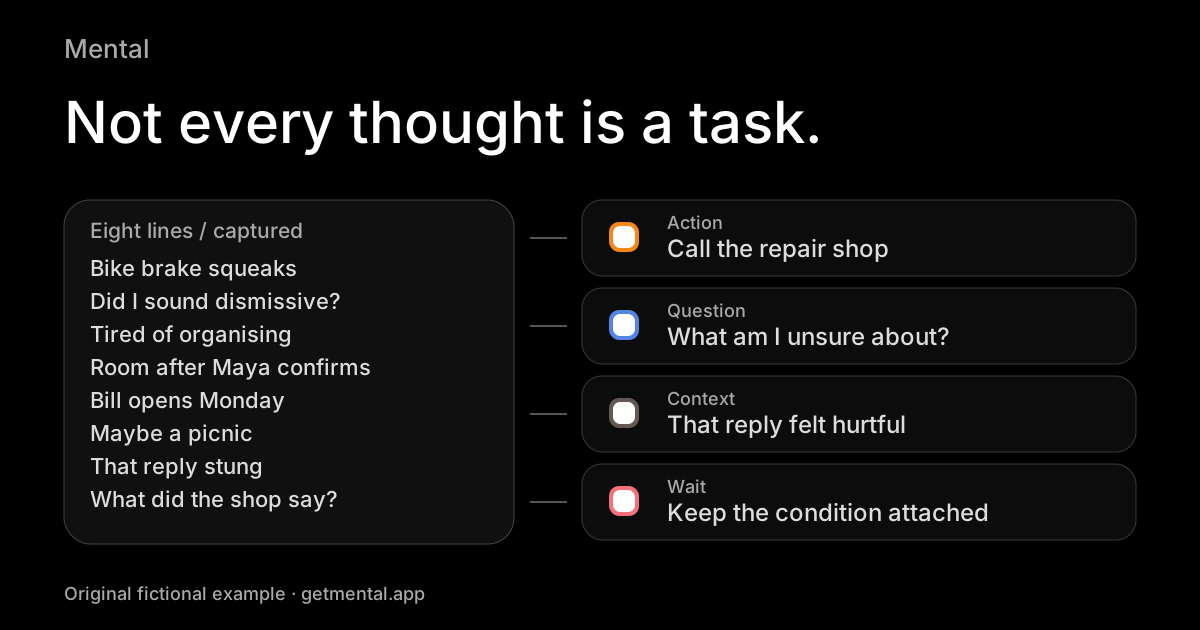
Eight lines. Not eight things to do.
Rowan writes this before leaving work. The list mixes errands, uncertainty, feelings and ideas because that is how it arrived. This example and its people are fictional.
The capture / still messy
Bike brake still squeaks.
Did I sound dismissive to Jo?
I am tired of being the person who organises everything.
Book the room after Maya confirms the date.
The electricity bill opens on Monday.
Maybe a picnic by the river on Saturday.
That short reply stung.
I keep forgetting what the repair shop said.
The first decision / how to read it
Ask what each line needs.
Can I act now? Is this a question? Does it explain my day? Am I waiting for something?
A line can belong in more than one place. The point is to choose a useful next place, not discover a perfect category.
Action / lines 1 + 8
Ask the repair shop one clear question.
“Call and ask whether the squeak needs a visit; write down their answer.” Two loose lines become one observable action.
Question / line 2
What am I uncertain about?
“Did I interrupt Jo, or am I reading too much into the silence?” Rowan has a question to consider, not an obligation to apologise without knowing why.
Context / lines 3 + 7
Keep the feeling as a feeling.
Being tired of organising and feeling hurt help describe this day. Neither needs a checkbox. A boundary or a conversation could follow later; neither is invented by the sorter.
Wait / lines 4 + 5 + 6
Keep the condition attached.
Room: wait for Maya's date, then book. Bill: check on Monday. Picnic: an idea, undecided. “Wait” can mean a dependency, a known time, or something you have not chosen.
Rowan's next action: call the repair shop before it closes and record the answer. The room stays conditional; the hurt stays in the notes. No other task is required to finish this brain dump.
A fictional line, given the right place
“That reply stung.”
Keep as context
Something felt hurtful. I do not yet know what I want to do about it.
Leave room for later
I can return to this without making “stop feeling hurt” a task.
Not every thought in a brain dump is a task.
Mental — getmental.app/brain-dump/
How to do a brain dump without growing the pile
Capture first. Write rough lines without deciding their importance as you go. You can stop when the page is enough.
Read once, if you want to. Mark an action, a question, context, or something that can wait. Leave uncertain lines as “not decided.”
Choose one next action. Give it a verb and an object. Keep any condition: “after Maya confirms” belongs with “book the room.”
Move only what needs another home. Put a dated item in the calendar you already use. Keep observations with your notes. Then stop.
If writing was the useful part, you can skip sorting entirely. If rereading makes the pile feel larger, save the plain capture and return another time. An unfinished classification is still a record.
Try your own sorting cards
Enter one thought per line. You choose every category; the page does not interpret or classify the words for you.
This free web tool is separate from the Mental app. Text stays in this page's memory, with no account, upload, autosave or AI processing. Reloading clears it. Download your text if you want to keep it.
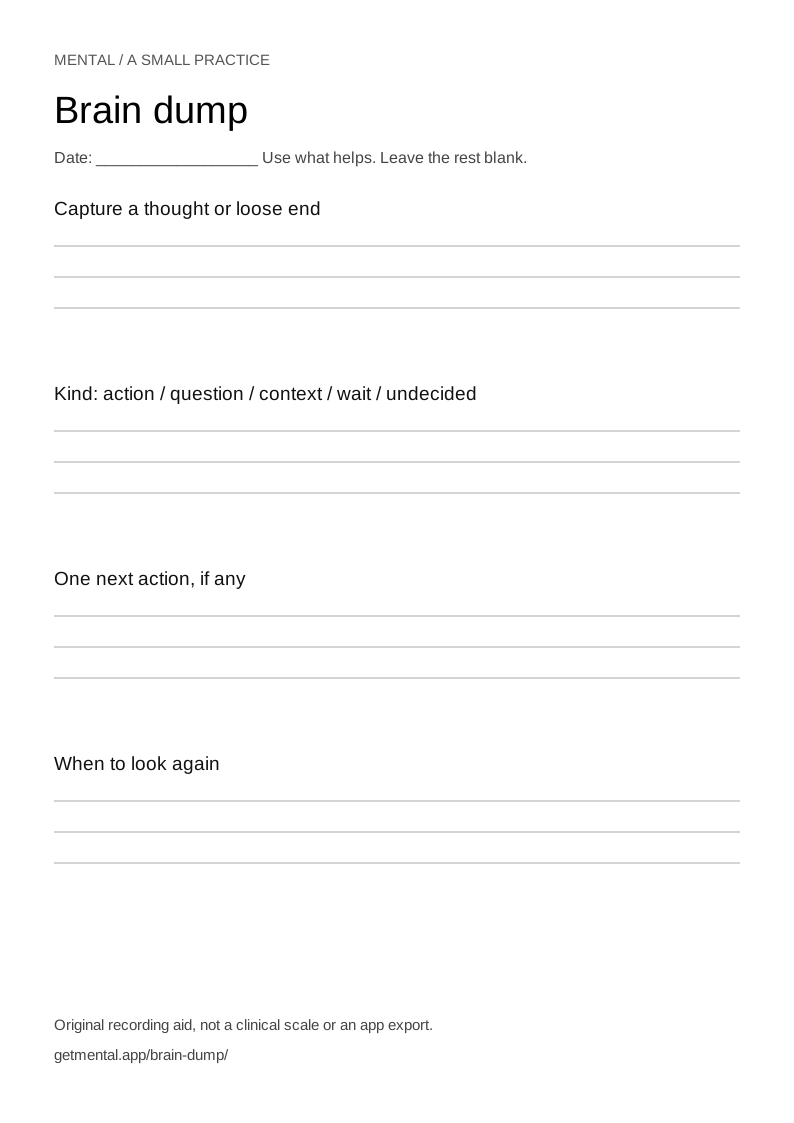
Prefer to stay on paper?
Use the same four places on an original one-page worksheet. Save the SVG, open it in a browser and print, or choose Save as PDF.
In Mental, a feeling and a short note can keep the context that would disappear in a task list. Keep actual next actions wherever you manage them. The web sorting cards are separate; they do not add anything to the app.
 MentalDownload for iOS