A time capsule
Put it away until the chosen date. The contrast between then and now is part of what you want to keep.
 MentalDownload for iOS
A letter to your future self
A letter to your future self records something of who you are now for a later you to read. It can hold an ordinary detail, an uncertainty or a question—not just a list of goals. Start with a page you control; this guide does not send or schedule letters.
Read a finished letter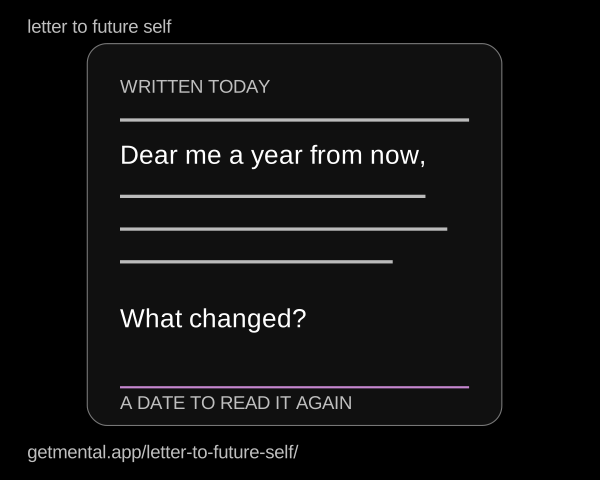
An original fictional letter
Dear me a year from now,
I am writing at the kitchen table while the washing machine finishes. I have started carrying a book on the bus, although I still reach for my phone first. Last Sunday, Sam and I cooked dinner without a recipe. It took ages. I would like more evenings like that.
Right now I am unsure whether to change jobs. I do not know what you decided, so I want to keep what matters to me today: learning something, having time outside work, and working with people I can ask questions.
I hope you still read on the bus. If your plans changed, tell me what you learned rather than whether you passed or failed. What ordinary part of your day would surprise me?
Take care,
Me, today
The kitchen table and the book on the bus give a later reader context. “Life is busy” would leave less of this particular day.
The job question remains a question. The writer does not pretend to know what will happen.
The letter leaves room for changed plans. It is not an exam set by your past self.
The closing question gives the future reader something to answer, if they want to.
A birthday, graduation, a transition or an ordinary date can all be reasons to write. Choose an opening date that means something to you; you can also choose to reread without sealing it away.
Put it away until the chosen date. The contrast between then and now is part of what you want to keep.
Reread when the question becomes relevant. Add a separate reply rather than silently rewriting the original.
These are different preferences, not a correct and incorrect method. If checking goals would make this feel like another obligation, you do not have to use the letter that way.
Write the opening date on an envelope. Put it in a known journal or folder. A reminder you create can include where it is stored.
Put the written and opening dates in the title. Keep a copy in storage you expect to be able to access. Check what any service promises before relying on future delivery.
This page does not collect, save, email or deliver your letter. Mental is not being presented as a scheduled-letter service. Do not assume a calendar reminder contains a backup of the letter itself.
Written on: ____ / Open on: ____
Dear me,
Today looks like…
Something I want you to remember is…
I do not know yet whether…
A question for you is…
From me, today.
You can skip any line. A short honest paragraph is a complete letter; a longer one is allowed too. If the intended reader is you, it does not have to impress a public audience.
Keep the original as a record of what mattered then. A later reply can explain what changed. Edinburgh’s reflection guidance explicitly recognizes that future aspirations may change; the exercise does not require predicting your future correctly.
You can keep it private. If you want to introduce the activity to someone else, share the fictional example or blank structure rather than a personal letter by default.
A letter preserves a chosen snapshot. A journal can keep the ordinary moments around it. In Mental, a feeling and an optional note can preserve context you may want to return to. You do not need to turn every check-in into a letter or every letter into a goal.
Download the original vector illustration. It contains only the fictional example and explanation shown here, never a reader’s private entry.
University of Edinburgh Reflection Toolkit; Columbia University Life’s letter activity. These are examples of reflection activities, not evidence of a guaranteed psychological outcome. The letter, annotations and blank structure are original Mental material.