 MentalDownload for iOS
Took the earlier bus. The café was closed, so I walked to the office with Sam. We talked about his move.
Journal vs. diary
A journal.
A diary.
Often the same book.
In personal writing, journal and diary can mean the same thing. Some people use different names for different styles, but a diary can contain reflection and a journal can record an ordinary day. You do not need two books to get the words right.
See the same day two ways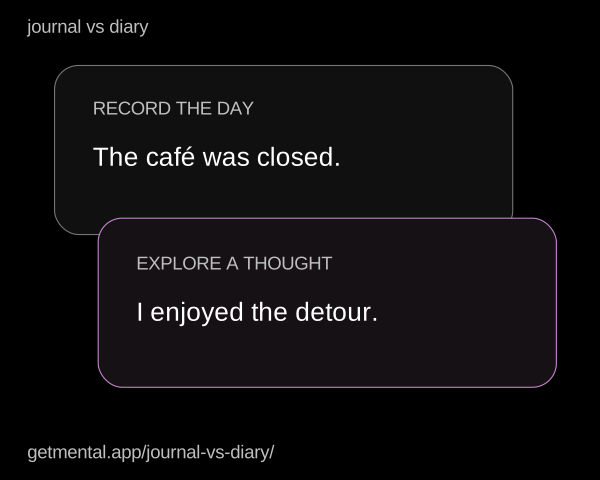
One fictional morning
The difference can be what you do—not what you call it.
Both fit.
I enjoyed the unplanned walk more than my rushed coffee. I have been treating mornings as something to get through. Could I leave earlier on Friday?
The first version preserves what happened. The second explores what it meant to this fictional writer. Combine them if you want both the scene and the thought. Either “journal” or “diary” is a reasonable personal label.
What the dictionaries actually support
Merriam-Webster includes personal activities, reflections and feelings in its definition of diary, and lists journal as a synonym. Its private-record sense of journal also includes experiences, ideas and reflection. That overlap matters more than a neat internet table that assigns all facts to one word and all thoughts to the other.
A preference
“I call my daily record a diary and my reading notebook a journal.” A useful personal convention.
Not a universal rule
“Diaries cannot contain reflection.” That restriction does not follow from the dictionary meanings.
You can still make separate books if that helps you find things or keep contexts apart. The point is that the distinction is yours to use, not a test you must pass.
Context can change the meaning.
A private record
“I kept a journal on the trip” and “I kept a diary on the trip” can describe very similar writing.
A British diary
In British English, diary can also mean a book or app for future appointments. That is an additional sense—not a rule that British diaries never contain personal thoughts.
A published journal
A scientific journal is a periodical. Advice about keeping a personal notebook is not advice about submitting an academic article.
An accounting journal
Journal can also refer to a financial record. The surrounding words tell you which meaning is intended.
Choose by the next thing you want to keep.
If you want to remember a day, record a concrete detail. If you want to think something through, follow a question. If you want to keep a passage from reading, keep its source too. You can mix these approaches, change them later or leave days blank without needing to rename the notebook.
The label does not make a notebook private. Storage, access, sharing and the service you use determine who can read it. Nor does “journal” automatically make an entry deeper or more useful than “diary.”
Do I have to write every day?
You can choose a daily practice, but the name alone does not enforce it. Merriam-Webster’s diary definition allows frequent intervals as well as daily records. A missed day is a gap in the record, not a reason to fabricate an entry.
What if a class or assignment defines them differently?
Follow the instructions for that specific assignment. A local convention can be useful even when the everyday dictionary meanings overlap. Ask what content and structure are expected rather than guessing from the label.
One place can hold the day and the thought.
Mental combines a feeling check-in with optional written context. That can be a short diary entry, a more reflective journal entry or simply one moment you want to keep. This terminology guide does not require using an app.
If the blank page is the actual difficulty, try three different ways to begin. If you want to collect other people’s ideas, see an annotated commonplace entry.
Keep the idea.
Download the original vector illustration. It contains only the fictional example and explanation shown here, never a reader’s private entry.
Sources and context
Merriam-Webster: diary; Merriam-Webster: journal; Oxford Learner’s Dictionaries: diary. The example morning and writing passages are original fiction. Writing styles here are options, not standardized categories.