A notebook
Good for browsing a sequence. An index points to pages; leave a note when an idea continues elsewhere.
 MentalDownload for iOS
Commonplace book
A commonplace book is a personal collection of passages, ideas and observations you want to keep. The useful part is not how finished it looks. It is being able to find something again.
Follow one entry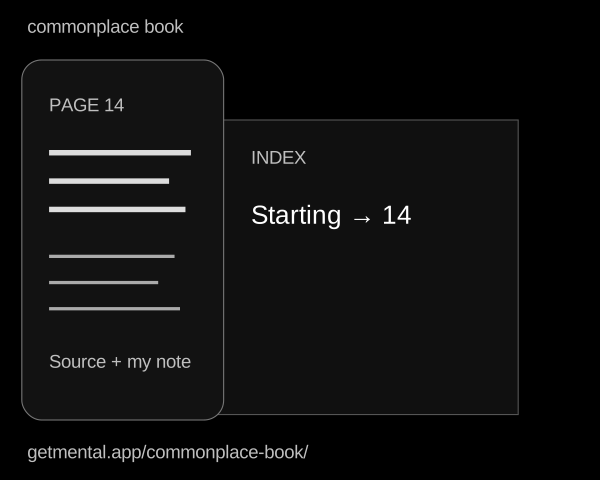
An original fictional notebook
Maya hears a line at a fictional workshop. She does not copy the entire talk. She keeps one idea and enough context to understand it later.
Attention 14, 31
Starting 8, 14
Waiting 22
“A small beginning still has a direction.”
Three weeks later, Maya is preparing a drawing session. She looks under “Starting,” returns to page 14 and writes an opening question: what could we sketch before we know the answer? This fictional continuation demonstrates reuse; it is not evidence that a notebook improves memory or creativity.
Fixed sections can work if you already know what you collect. They can also fill unevenly. A chronological notebook with a growing index is one alternative: number the pages, add an entry, and add a topic to the index when it becomes useful. One entry can appear under more than one topic without being copied twice.
This is an old problem, not a failure of your stationery. Yale Library describes a seventeenth-century commonplace book with empty spaces under some headings and overflowing material under others. Its owner changed headings as needs changed. That example shows one historical solution, not a rule for every commonplace book.
Good for browsing a sequence. An index points to pages; leave a note when an idea continues elsewhere.
Useful when you want to move and regroup entries. Keep the source on each card so it does not get separated.
Useful when search is how you find things. Give sources readable names, not only links that may stop working.
Collected ideas and the day you encountered them can share a book. Mark what is quoted and what is yours.
A passage, recipe, useful fact, overheard phrase or your own observation can belong. You do not need to extract a quotation from every book. If you paraphrase, label it as a summary. If you cannot verify the wording, do not present it as an exact quotation.
Revisiting might mean finding something for a conversation, comparing two ideas, writing an essay or enjoying a page again. It does not have to become another scheduled task. If a system makes you avoid the book, simplify the system before buying a better notebook.
Write what you know and mark the rest as uncertain. Try to recover the source before quoting publicly. A clear “source not yet found” is better than attaching a confident but invented attribution.
The emphasis is usually collected material and later reference, rather than only recording your own days. The boundaries overlap. You can keep both in one place; the labels do not dictate what a notebook is allowed to contain.
Words or idea to keep:
Source and where to find it:
My response, if any:
Topics or a place in the index:
Copy this into paper or a document you already use. No account, generator or special notebook is required.
Mental is a mood tracker and journal, not a dedicated citation manager. A note can keep why an idea mattered to you; keep any source information you will need alongside it. See what Mental’s Memory layer does rather than assuming it replaces an index.
Download the original vector illustration. It contains only the fictional example and explanation shown here, never a reader’s private entry.
University of Chicago Library on historical commonplacing; Yale Library’s notebook examples; Ryan Holiday’s own card method. Historical evidence and a practitioner’s preference do not establish health benefits. The notebook, workshop quotation and later scene on this page are original fiction.