Monday 19 October — morning
• Call the repair shop
• Send Jo the receipt
• Sort old bookmarks
○ Lunch with Jo at the park, 12:30
 MentalDownload for iOS
Bullet Journal / rapid logging
Three kinds of lines. Not three things to finish. Follow one ordinary day to see how tasks, events and notes do different jobs.
See the daily log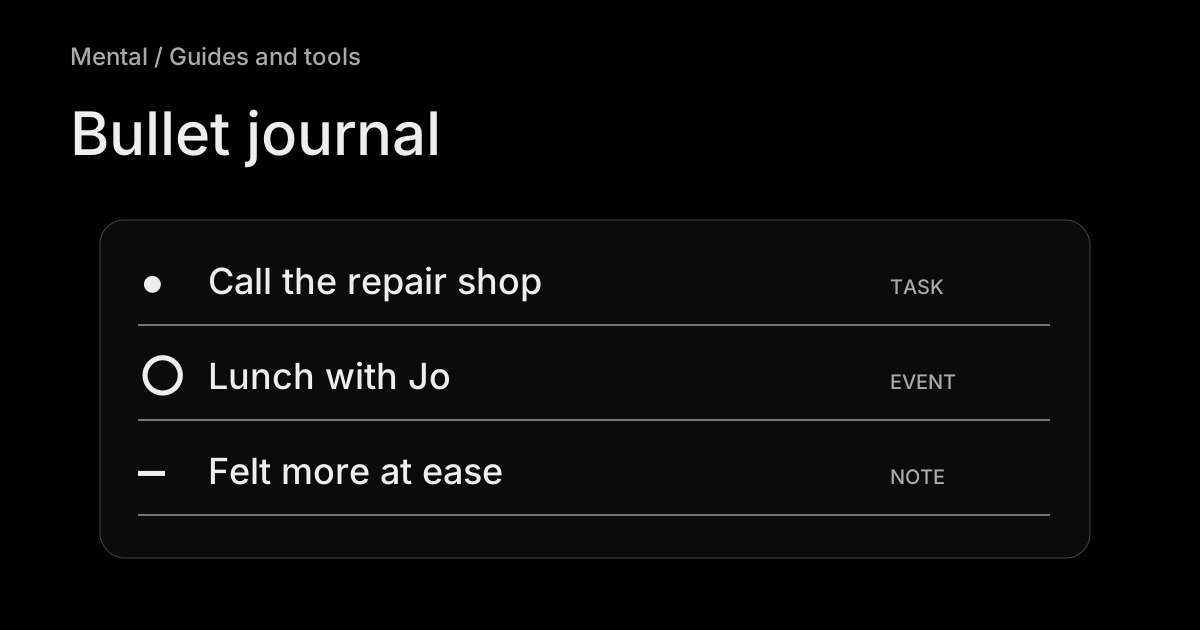
Rapid logging is the short-form notation in Ryder Carroll’s Bullet Journal method: • a task is something to do, ○ an event records an experience or a scheduled occasion, and – a note keeps a thought or observation. The daily log gathers these as the day unfolds.
You can begin with a date and a few lines. Decorative layouts are an option, not a prerequisite. This introduction covers one daily log; the official method explains its wider system of logs, collections and reflection.
This original fictional log starts with three tasks and a lunch plan. An observation joins them later. At evening review, only the tasks need a decision.
Monday 19 October — morning
• Call the repair shop
• Send Jo the receipt
• Sort old bookmarks
○ Lunch with Jo at the park, 12:30
The same page — evening
× Call the repair shop
> Send Jo the receipt
• Sort old bookmarks
○ Lunch with Jo at the park, 12:30
– I answer faster when I am worried
○ Lunch with Jo
What happened
– I felt less rushed afterward
What I noticed
A free web practice, separate from the Mental app. Your selections stay in this page; there is no account, upload, autosave, or AI processing. This exercise gives feedback, not a downloadable personal record. Use the worksheet below for a paper log.
Call the repair shop
Lunch with Jo at the park
I answer faster when I am worried
Ask whether it still matters and where it belongs. If it is actionable tomorrow, move it deliberately. If it belongs to a future date, the full method has a separate scheduling mark and future-log structure. If it no longer matters, cross it out. There is no need to disguise any of those choices as completion.
A line such as “Jo” is harder to review than “Send Jo the receipt.” Give the task enough words to tell you what doing it would mean. For an observation, enough words may simply preserve what you noticed.
The practice above explains three line types; it does not test mastery of the full method. Bullet Journal is a named method, and Mental is not affiliated with its publisher.
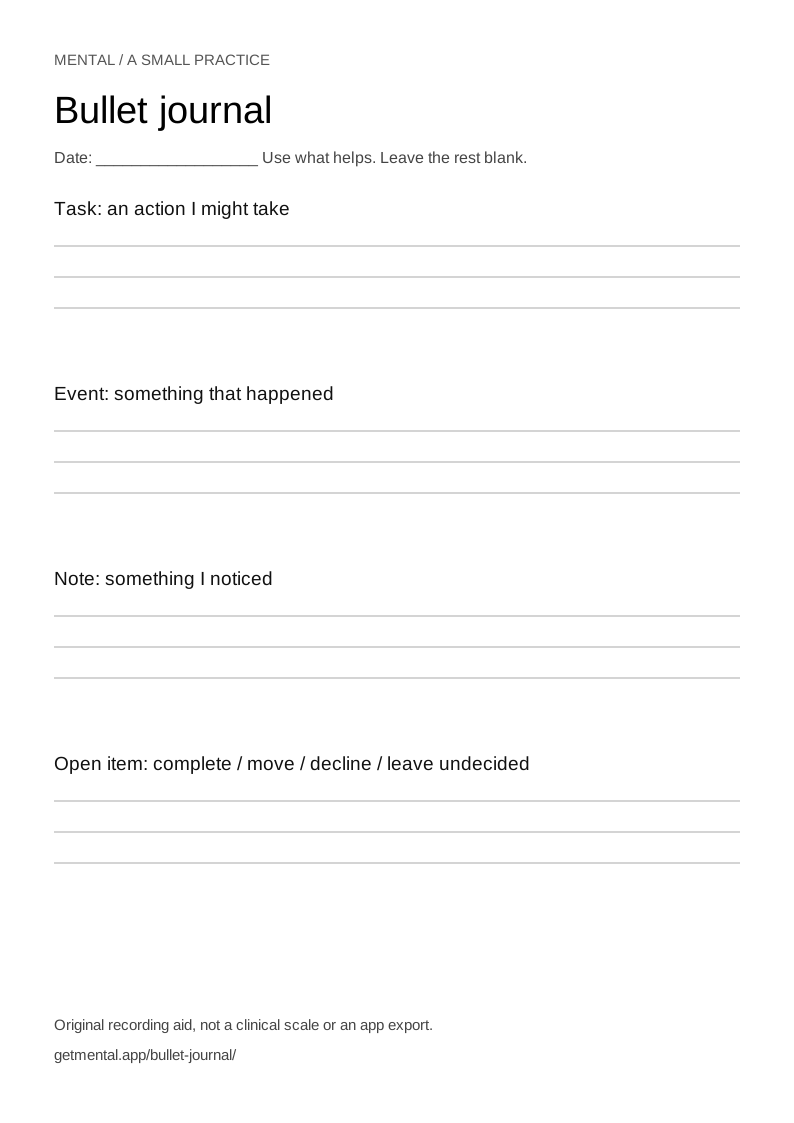
An original one-page worksheet for this practice. Save the SVG, open it in a browser, then print or use your browser’s Save as PDF. It is not an app export.
Mental is a mood journal, not a replacement for a Bullet Journal task system. You can keep the context behind an event in a Mental note while leaving actionable work in the place where you manage tasks.
Bullet Journal: official method overview. Method names belong to their respective creators. Examples and worksheets on this page are original and illustrative, not user stories, professional advice, or clinical scales.