It starts before it has a topic.
“I don’t know what to write” gets a line on the page. The writer does not need an interesting morning to begin.
 MentalDownload for iOS
Morning Pages / an ordinary beginning
Julia Cameron’s Morning Pages are three pages of longhand, stream-of-consciousness writing in the morning. You can begin with the kettle, the email you are avoiding, or “I don’t know what to write.”
Read an imperfect opening
The original practice has a particular form: three handwritten pages in the morning, following the thoughts as they come. An ordinary journal might hold a short account of yesterday, a question or a list. Morning Pages ask you to keep writing across those three pages without having to choose a worthwhile subject first.
That does not mean each line must be new. A complaint, a shopping thought and an unfinished sentence can sit together. You are making private pages, rather than composing something for a reader. This guide’s examples are invented; your own pages do not need an audience.
An original fictional opening
Tuesday morning / the beginning of page one
I don’t know what to write. I thought there would be a thought waiting when I opened this. The kettle is clicking again. Need to get more tea. I am still thinking about the email from yesterday and I don’t want to answer it before breakfast. I have written about that email already. Still here. My hand is cold. I want this to turn into a sensible plan but right now I mostly want toast. There is a van outside with its engine running. I wonder if I have clean socks.
This is a short illustrative opening, not three completed Morning Pages and not a quotation from Cameron.
“I don’t know what to write” gets a line on the page. The writer does not need an interesting morning to begin.
The email returns without a new insight. The example does not turn it into an action item just to justify mentioning it.
Tea, cold fingers, a van. These details can be what is actually in mind, even when they seem too ordinary to save.
An invented first line
Your first page does not need to be interesting.
You can write that it is still there: “I am thinking about the email again.” You can follow the next thought, even if it is about breakfast. Repetition does not create an obligation to produce an explanation by the bottom of the page.
Write the chores if that is what is in mind. You can notice the difference between “buy milk” and “I am tired of remembering everything,” but you do not have to find a deeper layer in every household detail. There is no need to make a mundane page sound profound afterwards.
The original exercise is defined by three pages, rather than a fixed number of minutes. Handwriting, notebook size and pauses vary. Give the practice some room in your morning if you want to try that form. A five-minute timer cannot certify that you completed it.
You may need a different way to write because of your hands, schedule, access or preference. A typed note, a voice recording or an evening freewrite can be your own adaptation. Name the change clearly: Cameron’s original Morning Pages are longhand and in the morning. Choosing an adaptation does not require pretending that distinction has disappeared.
Cameron’s FAQ tells participants not to share their Morning Pages. You do not need to show anyone a page to prove you did it. Think about the actual place you keep it: a notebook in a shared room and a device with a shared passcode create different kinds of access.
You can begin at the next opportunity without writing a retrospective account of every missed day. If the format feels like an obligation you do not want, reconsider the format. This page does not promise that finishing it will make you creative, productive or well.
For a smaller freewriting warm-up, put a notebook beside you and start here. Five minutes is an adaptation, not the original three-page practice. The timer pauses and resets; it does not save writing or judge what you wrote.
An optional timer, separate from the Mental app. It does not read, upload or save your writing. There is no account or AI processing. Keep your Morning Pages privately in the place you chose; this timer does not create a written record.
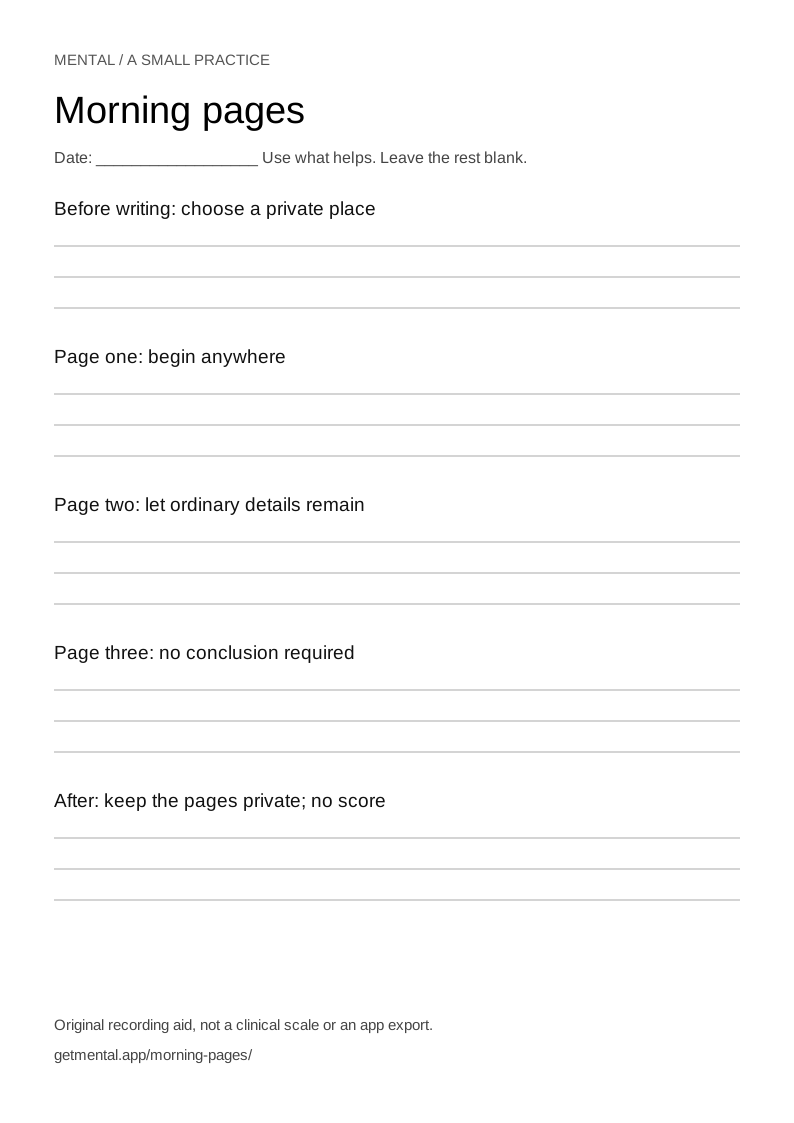
An original one-page worksheet for this practice. Save the SVG, open it in a browser, then print or use your browser’s Save as PDF. It is not an app export.
If you want a record of how you feel after writing, Mental can hold a short check-in with context. It is not an official Morning Pages tool. Your notebook can remain private; a check-in does not require copying the pages into the app.
For a shorter kind of journal entry from the outset, see three other ways to begin.
Julia Cameron’s official site explains Morning Pages; her FAQ discusses keeping them private. The example, observations and worksheet here are original. This is an independent introduction, not an official Cameron exercise, a reproduction of her book or a promise of a particular outcome.