Morning
Disappointed when the visit is cancelled.
 MentalDownload for iOS
Mood vs. emotion
An emotion often describes a response to something: relief when a reply arrives, or disappointment at cancelled plans. Mood can describe a broader emotional background whose cause is less clear. The distinction is useful, but it is not a stopwatch rule or a diagnosis.
Follow one fictional day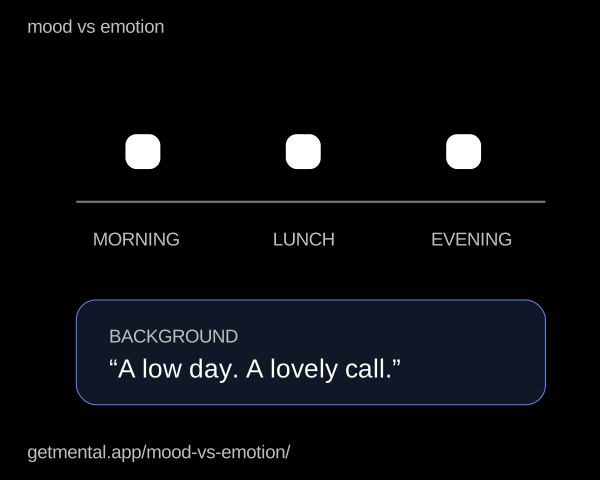
A fictional day / not measured data
Disappointed when the visit is cancelled.
Delighted by a friend’s unexpected call.
Relieved when an uncertain plan is settled.
“I felt low and withdrawn much of the day. The call was still genuinely lovely.”
If the writer chooses “happy” for the call, that can be accurate. If they describe the day as difficult, that can also be accurate. The two answers refer to different scopes.
Often connected to a particular event, person or situation. Ask: “What am I responding to?” The answer can involve thoughts, bodily experience and a possible response.
A more general emotional state or background. Ask: “How have things felt across this stretch of time?” You may not know what prompted it.
The APA Dictionary gives mood more than one psychological sense, including a short-lived state and a longer disposition. That is a reason not to reduce the difference to “emotion lasts exactly this long, mood lasts exactly that long.” Everyday language and research definitions vary.
Not knowing a trigger does not prove that an experience is a mood, and finding a trigger does not make the rest of the day irrelevant. These questions are prompts for a clearer description, not a classification algorithm.
A moment can be real without standing for the entire day. Say which period you mean.
A broad description can leave out exceptions. Keep a specific moment alongside it when it matters.
High energy can accompany different experiences. Add a feeling word and context rather than assigning one meaning to energy alone.
A label describes something noticed. It does not establish why it happened or prove a connection to sleep, food or an event.
At lunch, I felt delighted about the call.
Across the day, I mostly felt withdrawn.
I do not know what explains the background.
One exception I want to keep: laughing together.
These are original fictional examples, not prescribed answers. You can record a moment now and describe a longer period later without forcing the two into one number.
Feeling is used broadly in ordinary speech, including for an emotion, a bodily sensation or an impression. This page does not impose a single theory on every use. Add the actual description—“tense shoulders,” “disappointed about the email,” or “an uneasy afternoon”—when the broad word leaves things unclear.
A word or a single diary entry does not establish a diagnosis. This guide explains language for a personal record; it does not assess symptoms, recommend treatment or determine what support someone needs.
Mental lets you select a feeling and add optional context. A note can say what period you mean rather than making one cell stand for everything. When you read several entries later, keep gaps and exceptions visible. A collection of check-ins does not prove a cause.
For words to choose from, open the emotion grid. For the difference between several feelings at once and a change across time, read mixed emotions.
Download the original vector illustration. It contains only the fictional example and explanation shown here, never a reader’s private entry.
APA Dictionary: mood; APA Dictionary: emotion. Definitions were checked directly in the dictionary. All scenes and record sentences are original fiction. This is a general explanation, not a psychological test, validated scale or clinical assessment.