
How to read a mood chart
A day can hold more than one feeling. A chart can show that, or quietly hide it. Follow the same fictional fortnight through three views and see what each leaves out.
Fourteen dates, seventeen check-ins
Fictional data, September 1–14, 2026
Reading key: each labeled mark is one recorded feeling. Dates give order; the marks have no numeric height or distance. “No entry” marks a gap. Missing is not neutral.
The full record below stays available in every view. Daily summary means the last recorded label plus the number of check-ins: not an average or a whole-day diagnosis. Context means a note recorded alongside a feeling, not proof of its cause.
| When | Feeling | Context note |
|---|---|---|
| Sep 1, morning | Restless | Late train |
| Sep 1, evening | Relieved | Arrived |
| Sep 2 | No entry | |
| Sep 3, midday | Content | Lunch outside |
| Sep 4, morning | Apprehensive | Before presentation |
| Sep 4, midday | Proud | Presentation finished |
| Sep 4, evening | Lonely | Quiet kitchen |
| Sep 5, afternoon | Frustrated | Repair delayed |
| Sep 6, evening | Content | No context recorded |
| Sep 7, midday | Lonely | Lunch outside |
| Sep 8, morning | Disappointed | Plan cancelled |
| Sep 8, evening | Content | Read at home |
| Sep 9 | No entry | |
| Sep 10, morning | Curious | New project |
| Sep 11, afternoon | Restless | Waiting for a reply |
| Sep 12, morning | Relieved | Reply arrived |
| Sep 12, evening | Uncertain | Another question |
| Sep 13, evening | Content | Cooked dinner |
| Sep 14, evening | Hopeful | Made a plan |
What disappears when you keep one label?
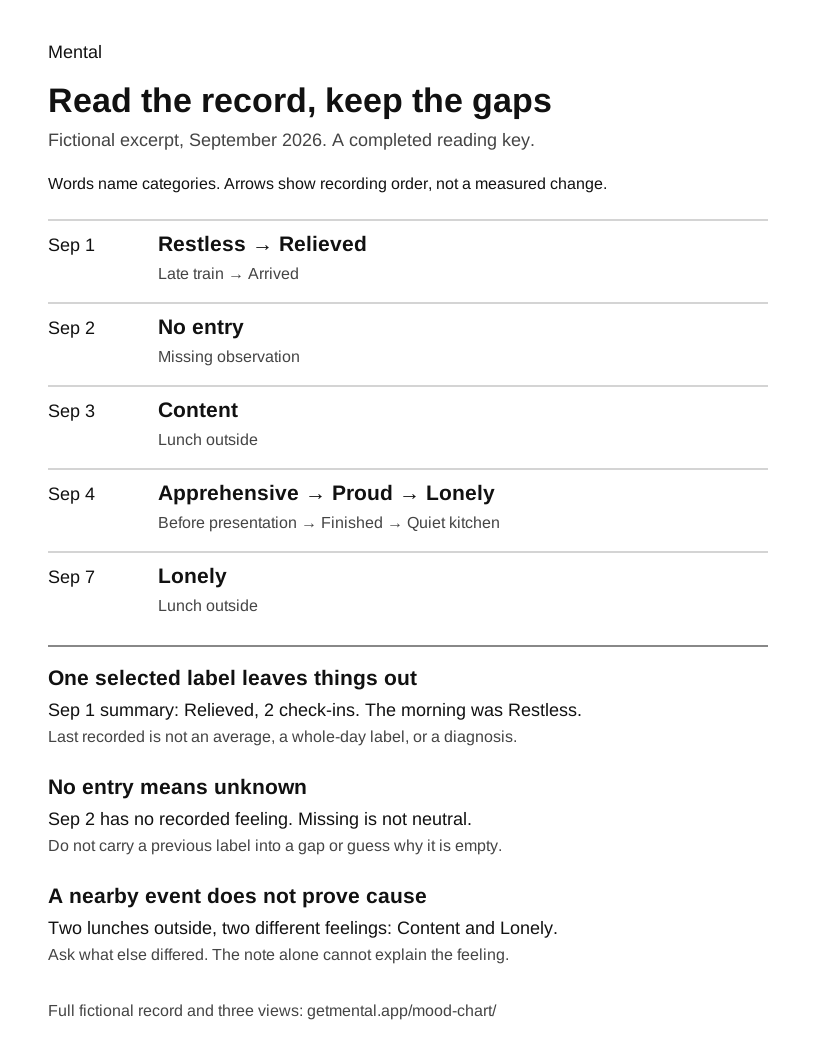
In the daily summary, September 1 reads “Relieved, 2 check-ins.” That is true of the last entry. It hides the morning’s “Restless.” Calling this a relieved day would turn one evening observation into a claim about hours we did not record.
September 4 makes the compression clearer: apprehensive in the morning, proud at midday, lonely in the evening. The summary keeps “Lonely, 3 check-ins.” The count tells you there is more to inspect; it cannot recover the earlier words. Read the individual entries before describing the day.
These labels are categories, not quantities. There is no meaningful arithmetic average of “Proud” and “Lonely” here, and no measured distance from one to the other. Position follows date and recording order only. This chart cannot say how strongly or how long a feeling lasted.
Two gaps are still two unknowns
September 2 and September 9 contain no entries. The person might have forgotten, been busy, chosen not to record, or had another reason. The record does not say. Neither gap means neutral, unhappy, or unchanged since the previous entry.
Even a date with an entry leaves most of that day unobserved. There are seventeen check-ins across twelve recorded dates, not fourteen complete daily accounts. More entries on September 4 mean more recorded detail, not necessarily a more eventful or difficult day.
Read the note without turning it into a cause
September 3 pairs “Content” with “Lunch outside.” It is tempting to decide that eating outside creates contentment. But September 7 pairs the same note with “Lonely.” Neither entry describes who was there, what happened beforehand, or what else mattered.
The context overlay places those notes beside their check-ins so you can ask better questions. It does not isolate an explanation. “What was different about those two lunches?” is supported as a next question. “Lunch outside improves mood” is not established by these observations.
If the question is about a story you tell yourself, try rereading a claim against a week of narrative notes. That example checks actions, later corrections, and counterevidence that a timeline of feeling labels cannot supply.
If you want to make your own brief records, the mood tracking guide explains what to capture. If a word is hard to find, the emotion grid starts with energy and pleasantness; its layout answers a different question from this timeline.
Keep the reading key
A completed, annotated excerpt puts September 1, 2, 3, 4, and 7 side by side. It preserves the early check-ins, the missing date, and the two different lunches.
Download the chart reading key
One-page SVG. Open the saved file in a browser and print with “fit to page.” The key contains fictional examples, with no fields to fill in.
About this chart
The Depression and Bipolar Support Alliance’s Wellness Tracker is an example of recording mood and other information over time. Its clinical context and scales are not used in this demonstration.
This dataset, its three views, and the reading key are original editorial examples by Mental. This is not a diagnostic tool, a clinical scale, or an app screenshot. It cannot identify a condition or establish a treatment effect. The website uses only the fixed fictional data shown here and accepts no personal chart entries.