A sleep journal for one night. With the estimates visible.
Being in bed, trying to sleep and being asleep are different parts of a night. A personal note can keep those distinctions without turning them into a score.
Arithmetic from remembered times, not a measurement of sleep.
A personal night note, with room for “not sure”
Record what you remember on the following morning: times, an interruption, and any context you want to keep. Label a guess as a guess. If you cannot estimate awake time, leave it unknown rather than entering zero.
This is an informal personal record. For a structured sleep diary to discuss with a health professional, use the NHLBI Sleep Diary or the format your clinician provides. The example, sheet and calculator here are not a validated clinical diary.
One night, three different durations
The following record is original fiction. The writer fills it in on the morning of 15 October, keeping remembered clock times apart from estimated awake minutes.
Morning note — 15 October
Got into bed at 23:10 and read. Put the book down and tried to sleep at 23:30. Final waking was 07:00; got out of bed at 07:20.
I think I took about 20 minutes to fall asleep, then spent about 10 minutes awake when a delivery van arrived. Those are estimates. I did not check the clock during the interruption.
Context: stayed at my sister’s flat. The street sounded unfamiliar. A little groggy at breakfast. This records the circumstances; it does not establish what caused what.
Read the numbers carefully
8 hours 10 minutes in bed: 23:10 to 07:20. This includes reading before trying to sleep and lying in bed after final waking.
7 hours 30 minutes in the calculator’s interval: 23:30 to 07:00. It starts when trying to sleep and ends at final waking.
About 7 hours estimated sleep: subtract the estimated 20 + 10 = 30 awake minutes from that 7-hour-30-minute interval.
The arithmetic is exact for the entered numbers. The numbers about awake time are still estimates.
“I was in bed for eight hours” does not tell the whole night.
Fictional record
In bed — 23:10–07:20 Trying to sleep → final waking — 23:30–07:00
Different quantities
Time in bed — 8 h 10 min Estimated sleep — about 7 h
In this example, reading, settling, an interruption and time after waking account for the difference. No sleep score or assessment follows from these durations.
Mental — getmental.app/sleep-journal/
The next record can be less tidy
16 October — missing detail
“Tried to sleep around midnight. Woke at 06:50. Remember being awake twice, but cannot estimate for how long.”
Keep awake time unknown. The clock interval alone is not an estimate of sleep.
17 October — two episodes
“Slept after a night shift, then again in the evening. Wrote the two episodes separately. Timing of the first is uncertain.”
Keep a manual record of each episode. One interval cannot represent this whole day.
Estimate one overnight interval
A free web tool, separate from the Mental app. Your answers stay in this page’s memory: no account, upload, autosave, or AI processing. Reloading clears them; download your text to keep it. Aggregate site measurement, when enabled at release, does not include these fields.
What the calculator can represent
Enter the time you tried to sleep, the final waking time, and an estimate of all awake minutes between them. Include the initial time waiting to fall asleep as well as later awake periods. Do not include reading before you tried to sleep, or time spent in bed after final waking.
It handles one interval shorter than 24 hours, including an interval across midnight. Equal start and end times are ambiguous. Split sleep, several episodes or uncertain awake time call for a manual note rather than a forced total. It does not measure sleep stages or interpret the result.
When you return to several records
Read the context as context. “An unfamiliar street; interrupted night” keeps two observations together. It does not establish that the street caused the interruption, or that the same thing will happen elsewhere. Keep the uncertainty alongside any question you want to discuss.
Keep a personal night note on paper
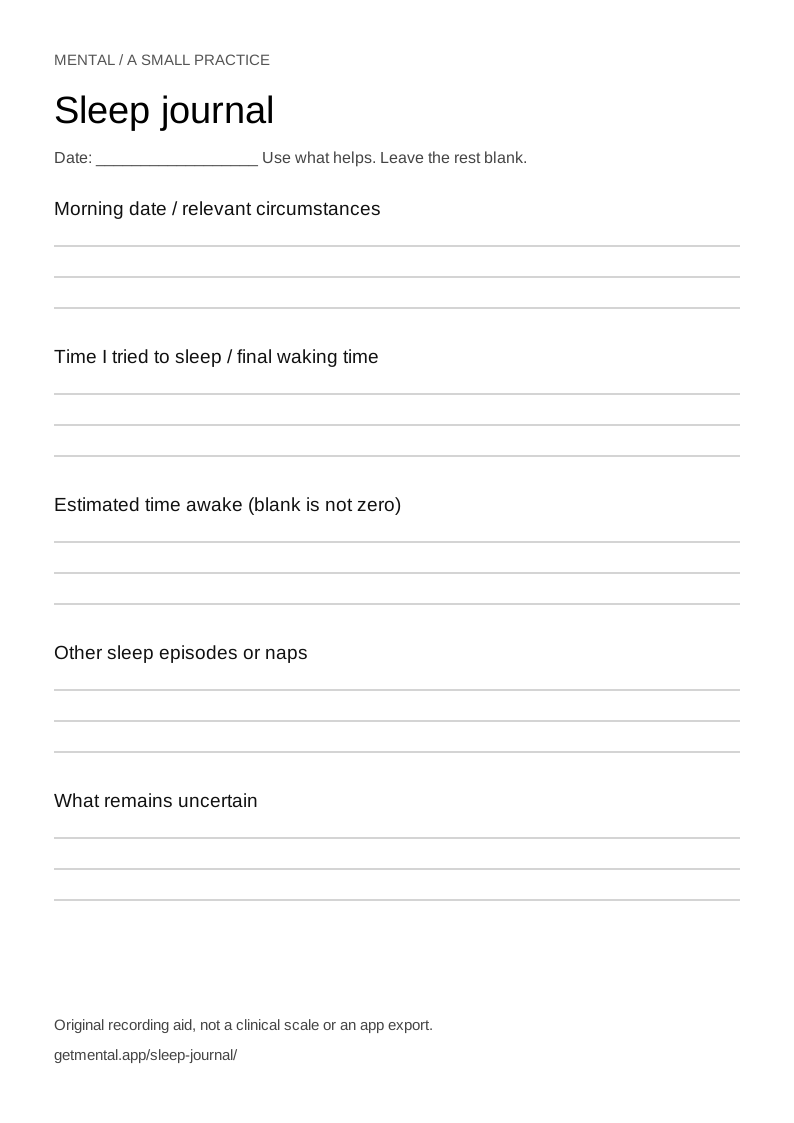
An original one-page recording aid, not a clinical form. Save the SVG and print it, or use your browser’s Save as PDF. For a formal diary, use the NHLBI resource linked below.
You can record how you feel in Mental and keep a note about the night. Mental is not a sleep tracker or a diagnostic sleep diary. This web calculation does not read Apple Health or write to your journal.
The NHLBI Sleep Diary records sleep and daytime context for discussion with a health professional. The Consensus Sleep Diary paper describes a standardized diary. Our fictional examples and single-interval arithmetic are neither of those instruments and offer no diagnosis or assessment of sleep quality.
 MentalDownload for iOS