14 October / one fragment
Blue stairs
Remembered: blue tiles on a staircase. A bell somewhere.
Uncertain: nothing before or after that.
On waking: curious.
This is a finished entry, even though the remembered scene is unfinished.
 MentalDownload for iOS
Dream journal / fragments count
You wake with a blue staircase in mind. No beginning, no ending. A dream journal can keep that one detail, how you felt on waking and what you are unsure about. A complete story is optional.
See three kinds of entry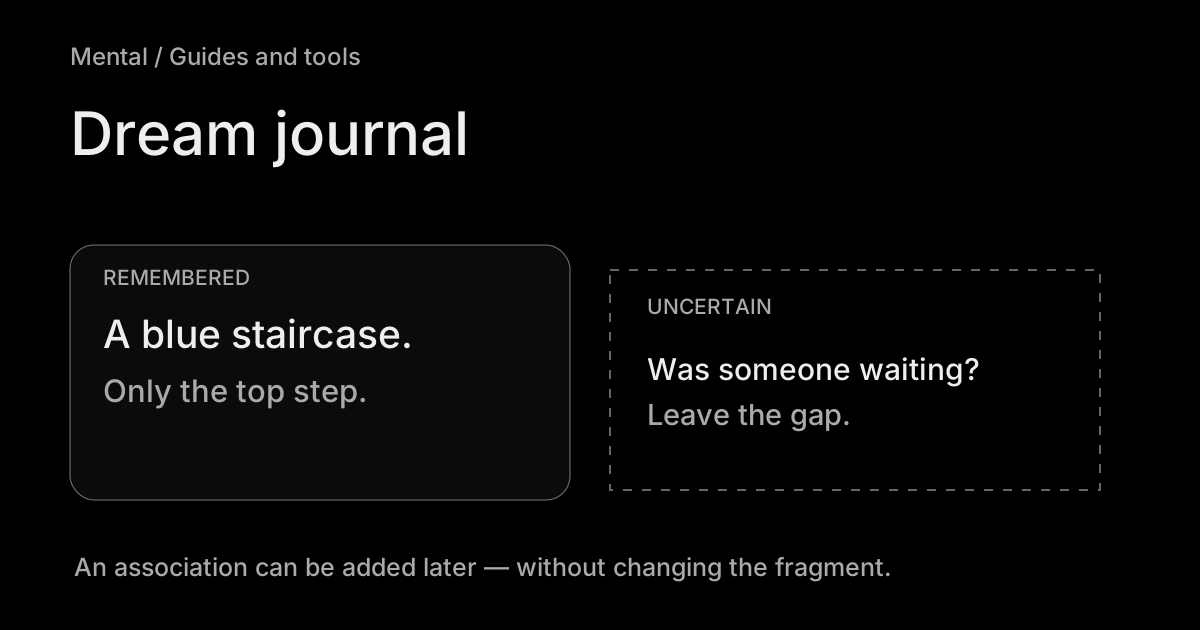
A dream journal is a record of what you remember from dreams. It can be a few words, a sketch, a spoken note or a longer account. Choose a notebook or device you can use comfortably when you wake; you do not need to interrupt your sleep to create an entry.
If nothing comes back, “I do not recall a dream” can be the whole entry. You do not have to fill the space by guessing.
Three original fictional records
14 October / one fragment
Remembered: blue tiles on a staircase. A bell somewhere.
Uncertain: nothing before or after that.
On waking: curious.
This is a finished entry, even though the remembered scene is unfinished.
15 October / a fuller scene
Remembered: I was returning a library book at a station counter. My suitcase was full of cups. The librarian asked me which platform I wanted, then slid the book along a tiny railway on the desk. I waited for it to come back.
Uncertain: I cannot remember the book’s title.
On waking: amused. Inside the dream, the wait had felt ordinary.
There is more to record here. That does not make it a better entry.
19 October / an uncertain scene
Remembered: a blue staircase again. Someone waiting at the top.
Uncertain: perhaps my sister, but I cannot picture a face. There may have been a door. I do not remember opening it.
On waking: uneasy.
“Perhaps my sister” stays tentative. The record does not quietly turn it into “my sister was there.”
A whole entry can begin here.
The gap can stay a gap.
Give entries short, searchable titles and keep their dates. You can look for a word, place or feeling when you want to revisit something. A notebook index, a text search or a short list beside voice recordings can help you find the original record without rewriting it.
In our fictional notebook, stairs appear in three entries: outside a house on 7 October, blue and tiled on 14 October, and with someone at the top on 19 October. The observation is “stairs appear in three notes.” It does not establish what stairs mean, or that all three dreams were the same.
Added on 19 October, afternoon
“The blue tiles remind me of the pool near my childhood home. I thought of that while walking past a swimming lesson today. I do not remember a pool in the dream.”
The association may be interesting to the writer. It is still a waking thought added later. Keep it beside the morning entry instead of inserting the pool into what was originally remembered.
Choose the format you can return to. A sketch can keep a shape; text is easy to search; a voice note can hold a detail when you do not want to type. If you use audio, a short dated title or written index can make a growing collection easier to browse. None of these formats needs to win a contest for being the “right” way.
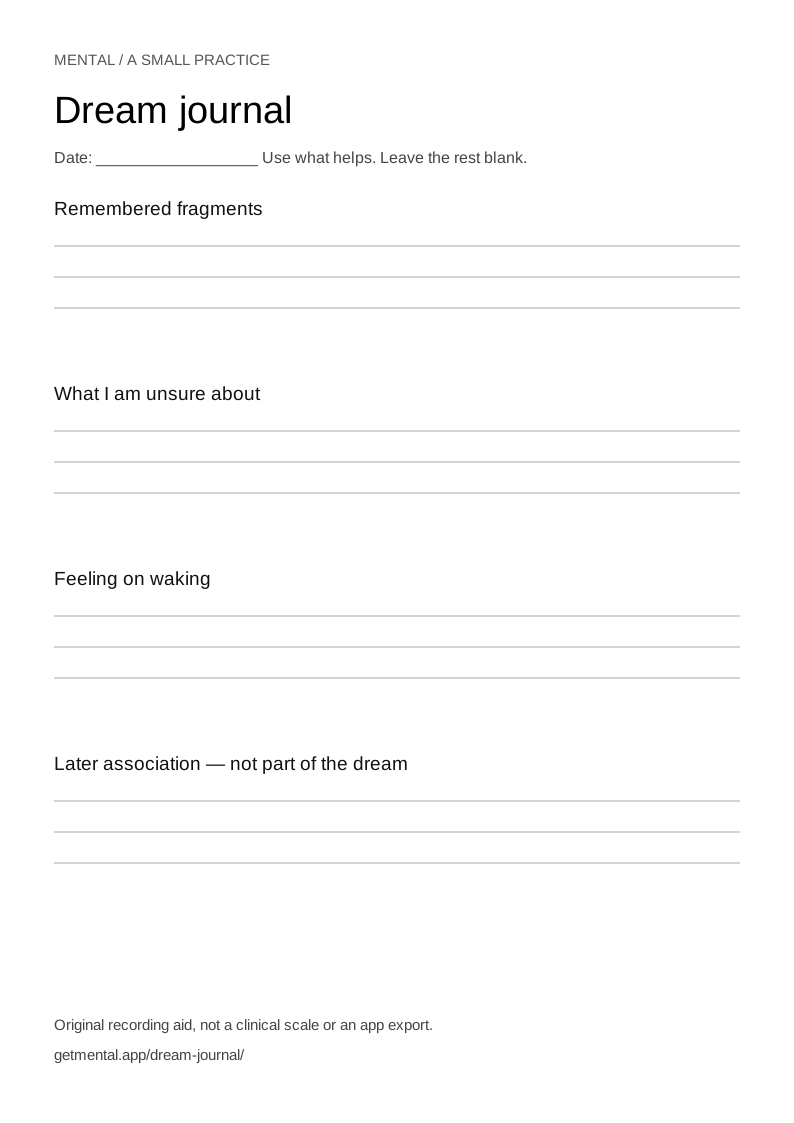
Keep the remembered part, uncertainty and waking feeling on separate lines. A later association can stay blank. For a dated archive, put the date in your first line or the name of the file you keep.
A free web tool, separate from the Mental app. Your answers stay in this page’s memory: no account, upload, autosave, or AI processing. Reloading clears them; download your text to keep it. Aggregate site measurement, when enabled at release, does not include these fields.
An original one-page worksheet for this practice. Save the SVG, open it in a browser, then print or use your browser’s Save as PDF. It is not an app export.
You can manually put a fragment in a Mental note and record how you feel now. Mental is not a dream interpreter or a dedicated dream database. Nothing you enter on this web page transfers into the app automatically.
A dream journal records an experience; it cannot verify a memory or tell you what an image predicts. This guide does not promise better dream recall or teach lucid dreaming. If dreams or sleep are persistently distressing, keeping a record need not be your only source of support.
In How to start (and keep) a dream journal, writer Charmaine Li describes her own practice and ways of recording and revisiting dreams. It is a practitioner’s account, not proof of a benefit for everyone. Our entries, later association and worksheet are original fictional examples. The record format here preserves uncertainty rather than supplying an interpretation.